Introduction
Marcia Ramos-e-Silva, Maria Cristina Ribeiro de Castro and Maria Teresa Ochoa Mycobacterial Infections
Chapter Contents
In 1896, the name “mycobacteria” was given to a large group of bacteria that produce filamentous pellicles similar to molds when grown in liquid media. These organisms are thin, slightly curved to straight, non-motile and non-spore-forming, with a waxy coating that makes them resistant to most stains. Mycobacteria are also acid-fast, which means they are not readily decolorized by acid after staining. Of the >170 species in the genus Mycobacterium, a number of them may or may not be pathogenic depending on the immunologic state of the host, whereas M. leprae and M. tuberculosis are virulent and constitute an important world health problem. Research on Hansen disease (leprosy) has been greatly hampered by the inability to culture the organism, which has the longest doubling time of all known bacteria, but the discovery of the genomic sequence of M. leprae in 2001 was a significant advancement. Although the classic mycobacterioses – Hansen disease and tuberculosis – have been known since antiquity, over the past few decades there has been a worldwide explosion in the incidence of mycobacterial infections. Several factors have played a role in this increase, including the emergence of resistant strains of M. tuberculosis and a rise in the number of immunocompromised hosts, including those with AIDS. In Table 75.1, the different species of mycobacteria that are associated with cutaneous disease are outlined utilizing Runyon’s classification scheme.
This chapter addresses the mycobacterial species that are of greatest interest to dermatologists: M. leprae, M. tuberculosis, and non-tuberculous mycobacteria that cause cutaneous infections.
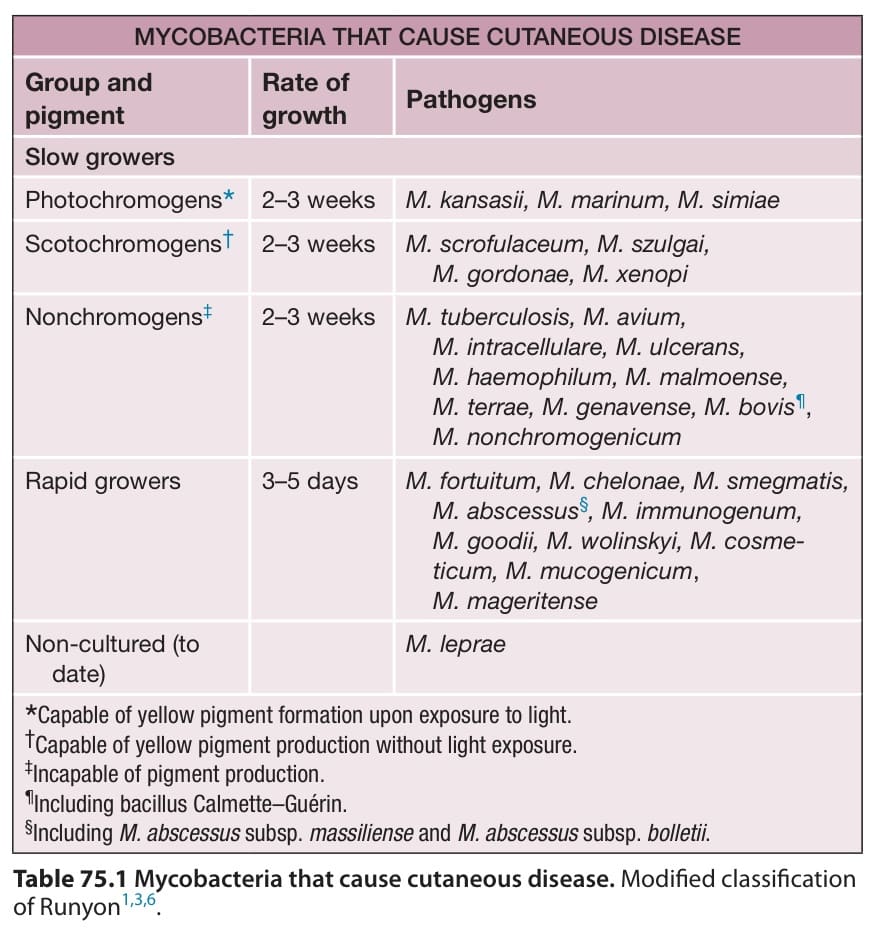
Table 75.1 Mycobacteria that cause cutaneous disease. Modified classification of Runyon.