HPV VACCINES
Three decades ago, recombinant DNA technology was used to generate a prophylactic subunit vaccine that consists of the L1 major capsid protein, which self-assembles into empty capsids designated as viruslike particles (VLPs) (see Fig. 79.1). VLPs resemble native virions morphologically and immunologically, and they carry neutralization epitopes on their surface. However, as a safety advantage, VLPs do not contain potentially oncogenic viral DNA and cannot replicate. Systemic immunizations with VLPs induce high-titer, long-lasting, and typerestricted neutralizing antibodies.
Prophylactic vaccinations in several animal models of papillomavirus infection were spectacularly successful in preventing natural or experimental infection of skin and mucosa. In phase I/II human trials, systemic immunizations with VLP-based vaccines were non-toxic and highly immunogenic, inducing robust neutralizing antibody responses. Based on these promising results, large-scale prophylactic vaccination trials were conducted to evaluate the safety and efficacy of two agents in preventing genital HPV infection and associated lesions in young women: (1) a quadrivalent vaccine of HPV-6, -11, -16, -18 VLPs (Gardasil®; Merck); and (2) a bivalent vaccine of HPV-16, -18 VLPs (Cervarix®; GlaxoSmithKline). Study endpoints were detection of HPV DNA and the development of dysplasias (squamous intraepithelial lesions) or (for the quadrivalent vaccine) anogenital warts. These studies showed near-complete protection (>90% vaccine efficacy) that was typerestricted against vaccine-type HPV infection. In addition, there was 100% protection in preventing genital warts as well as low- and high-grade CIN, VaIN, and VIN that were associated with the vaccine HPV types (for at least 10 years). The quadrivalent vaccine was also found to be nearly 90% effective in preventing both genital warts caused by HPV types 6 and 11 in young men and AIN. While post-marketing evaluation of the duration of efficacy of the vaccines is ongoing, trial results have demonstrated stabilized antibody titers for at least 10 years after vaccination, suggesting induction of a strong B cell memory response. Also, in studies where girls and boys between the ages of 10 and 15 years were vaccinated, more than 99% have seroconverted, and they developed antibody titers that were even higher than those in women 16 to 23 years of age.
Because these first two commercial HPV vaccines contain HPV-16 and -18 VLPs, they induce protection against the two high-risk HPV types that together account for ~70% of cervical cancers and high-grade CIN. Of note, they may offer limited cross-protection against closely related HPV-31, -33, and -45. More recently, the 9-valent vaccine
(Gardasil®9) was licensed which contains VLPs for HPV-6 and -11 as well as high-risk HPV types 16, 18, 31, 33, 45, 52, and 58. Together, these seven high-risk HPV types have been identified in ~90% of cervical cancers. Because it is not 100%, vaccinated women should continue to have Pap smears performed.
The three HPV vaccines that have been introduced worldwide over the past fifteen years are aimed at achieving universal vaccination of children and adolescents, ideally at 11 or 12 years of age. This would be prior to the onset of sexual activity and when the strongest immune response is generated, with the CDC recommending “catch-up” shots for those ages 13–26 years. Four years after implementing a national quadrivalent HPV vaccine program in Australia that was aimed at girls and young women and resulted in 70% coverage, genital warts nearly disappeared in women and heterosexual men <21 years of age. In addition, high-grade cervical lesions significantly declined, with both outcomes demonstrating vaccine effectiveness at the population level.
The 9-valent vaccine is FDA-approved for females and males ages 9 to 45 years to prevent anogenital warts as well as cervical, vulvar and vaginal cancers, anal cancer, and HPV-related head and neck cancers. Of note, both the bivalent and quadrivalent vaccines have been removed from the US market due to low demand, but are available in other countries. The CDC views vaccination of inadequately vaccinated adults 27 to 45 years of age as optional as a greater percentage of these individuals have already been exposed to HPV.
Because the HPV vaccines have no therapeutic efficacy against preexisting infection or disease, the benefit of vaccinating older patients is considerably smaller. To date, there are no randomized, placebocontrolled trials demonstrating therapeutic efficacy of licensed HPV vaccines in the treatment of genital, cutaneous, or laryngeal warts. Although vaccinating males (e.g. with Gardasil®) is less cost-efficient than vaccinating females, this intervention likely increases vaccine efficiency in the population as a whole due to herd immunity. Vaccination is also expected to lead to a drastic reduction in anal dysplasia and cancer (particularly in MSM) as well as an estimated one-third reduction in the incidence of oropharyngeal cancer. In 2020, the WHO launched a 90-70-90 strategy for the global elimination of cervical cancer via the vaccination of 90% of girls by age 15 years, screening 70% of women by 35 years of age and again by 45 years of age, and treating 90% of women with cervical precancer or cancer.
Currently, HPV vaccines are approved for use as either two- or threedose regimens according to age. However, questions remain regarding the duration of vaccine efficacy and cross-protection with two doses (or even one dose) as compared to three doses. To date, several hundred million doses of HPV vaccines have been administered with retention of a good safety profile. There is also no indication of replacement by non-vaccine-targeted HPV types. The information gained from ongoing studies will aid in answering additional questions, including: duration of protection (when to boost if at all); possible longer-term benefit of
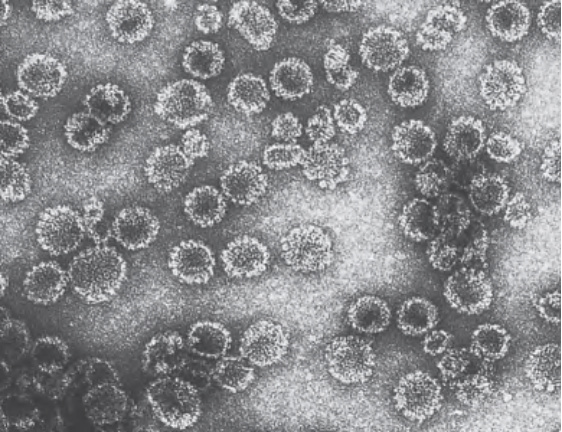
Fig. 79.1 Transmission electron photomicrograph of purified HPV-16 virus- like particles (VLPs). A prophylactic vaccine that contains HPV-6, -11, -16, -18, -31, -33, -45, -52, and -58 VLPs has been approved for the prevention of anogenital warts and cancers. Following expression in cell culture, the L1 capsid protein self-assembles into VLPs (empty capsids ~50 nm in diameter devoid of HPV DNA) that display type-restricted and neutralization surface epitopes similar to native virions. Courtesy Saeed Shafti-Keramat.
preventing re-infection; utility of (pseudovirion) surrogate assays for neutralizing antibodies; and correlates of protection.
As an alternative approach for generating broader-spectrum vaccines, genetic engineering has been employed to develop L1 VLPs that also express type-common epitopes of the minor capsid protein L2 (e.g. the highly conserved “RG1” peptide of HPV-16 L2 that contains a cross-neutralization epitope), which can induce cross-protective immunity to a variety of mucosal and even cutaneous HPV types. In a preclinical genital challenge animal model, vaccination with HPV16 RG1-VLP provided broad protection against virtually all high-risk mucosal HPVs, in addition to inducing cross-neutralization against low-risk mucosal types, common cutaneous types (HPV-2, -27, -57, -3), and oncogenic β types (HPV-5, -8). As part of the US National Cancer Institute PREVENT program, a phase I first-in-human trial of a RG1-VLP vaccine candidate is planned. Such monovalent VLP vaccines may become a cost-effective alternative strategy for implementing national HPV vaccination programs, especially in low-income countries that cannot afford multivalent HPV vaccines or cytology (Pap) screening, yet carry >80% of the worldwide burden of cervical cancer.
Successful experiments in animals have encouraged efforts to develop therapeutic vaccines against HPV infections. Most papillomavirus infections are self-limited, and it is generally agreed that a cellular immune response (albeit poorly understood) is required for clearance of infection. Cell-mediated immunity to L1 or L2 is unlikely to exhibit therapeutic efficacy, as capsid proteins are expressed neither in basal cells that harbor HPV DNA nor in progressed lesions that do not produce virions. Candidate rejection antigens are the E6 and E7 oncoproteins, which are selectively retained and expressed in cervical dysplasia and cancer, and E1 or E2 proteins, which are required to maintain the viral genome as an episome. Multiple strategies have been employed, including vaccinations with papillomavirus proteins fused to or combined with immunostimulants or dendritic cells in addition to attenuated viral or DNA expression vectors.
Chimeric VLPs have been engineered to incorporate an early protein such as E7 into an L1 or L1/L2 capsid. The induction of cytotoxic T-lymphocyte responses to the E7 oncoprotein, in addition to antibodies directed against the L1 capsid protein, provides both therapeutic and prophylactic benefit in mouse tumor models. These strategies may prove effective in low-grade dysplasia or condylomata that have a high likelihood of spontaneous regression. However, mechanisms of immune evasion such as down-regulation of MHC type I expression may diminish the success of therapeutic vaccines and, thus, favor their application as an adjunct to established ablative therapies. Also, safety issues associated with live attenuated or DNA vectors and with vaccines containing E6 or E7 oncoproteins are complex.
Howley PM, eds. Fields Virology. 5th ed. Philadelphia: Lippincott Williams & Wilkins; 2001:2299–2354.10. Bernard HU, Burk RD, Chen Z, et al. Classification of papil-
Evaluation of a novel broad-spectrum PCR-multiplex genotyping assay for identification of cutaneous