HEAD LICE
Synonyms: Pediculosis capitis “Cooties”
Key features
This worldwide infestation is caused by bloodsucking, wingless, six-legged insects that live only on the hairs of the scalp
Diagnosis is usually confirmed by the presence of 0.8 mm eggs
(“nits”) firmly attached to scalp hairs
Head lice are spread by head-to-head contact as well as by fomite transmission
Resistance to traditional over-the-counter preparations (pyrethrins, permethrin) is growing
Newer treatments, including topical ivermectin, are now available
Introduction
Lice are bloodsucking, wingless insects belonging to the suborder Anoplura. Twelve million cases per year occur in the US alone, and resistance to traditional treatments is increasing. Prescription products (e.g. topical malathion, topical or oral ivermectin) are often needed to treat resistant cases, requiring greater physician involvement.
History
Head lice have infested mankind for thousands of years. Nits have been found on the hair of Egyptian and Peruvian mummies.
Epidemiology
Head lice are found worldwide with no strict limitations based upon age, sex, race, or socioeconomic class. Children 3–11 years of age have the highest incidence. The worldwide prevalence in school-aged children was estimated to be 19% in a recent meta-analysis, with prevalences as high as 60% in some countries. Infestation with head lice is more frequent in girls, probably due to their tendency to have longer hair as well as to exchange brushes, barrettes, and other hair accessories. Head lice are distinctly uncommon in African-Americans, as head lice in the US are unable to properly position themselves to lay eggs on coarse curly hair.
Pathogenesis
The head louse, Pediculus capitis, is a highly host-specific insect approximately the size of a sesame seed (2–3 mm; Fig. 84.7). These obligate human parasites feed on the blood of the host approximately every 4–6 hours. The female louse lives for 30 days, during which time she lays between 5 and 10 eggs a day on hair shafts (Fig. 84.8). The
oval egg capsules (nits) measure 0.8 mm in length and are usually laid close to the scalp for warmth; in general, eggs located within 1 cm of the scalp are unhatched. In warm climates, however, viable nits may be found 15 cm or more from the scalp, especially in the area above the nape of the neck. The nits are cemented to individual hairs by a proteinaceous matrix that closely resembles the amino acid constituents of the human hair shaft itself. Head lice rarely live for more than 36 hours away from the host without a blood meal; however, given an appropriate temperature (82–90°F/28–32°C) and level of humidity (70%–90%), nits can survive and hatch after 10 days away from the host. Transmission occurs via direct head-to-head contact or by fomites such as combs, brushes, blow-dryers, hair accessories, bedding, helmets, and other headgear.
Clinical Features
Skin findings of head lice infestation are limited to the scalp, behind the ears, and the nape of the neck. The classic symptom of intense pruritus varies among patients. It may take 2–6 weeks following an initial infestation before pruritus is evident, reflecting a delayed immunologic response to components of the lice saliva or excreta. In repeat infestations, pruritus develops within the first 24–48 hours. However, some individuals are asymptomatic “carriers”. Although excoriations, erythema, pyoderma, and scaliness of the scalp and posterior neck are common findings, definitive diagnosis is made by the identification of nits and/or adult lice on the scalp hair. Viable eggs are usually tan to brown in color, whereas hatched eggs are clear to white (Fig. 84.9).
Patients occasionally present with a low-grade fever and lymphadenopathy due to a secondary bacterial infection. Head lice can carry S. aureus and Str. pyogenes on their surfaces and are a common cause of pyoderma of the scalp. There is increasing evidence that head lice may harbor other pathogens such as Bartonella recurrentis, B. quintana, Coxiella burnetii, and Acinetobacter spp.; however, it is unclear whether this is associated with disease transmission.
Pathology
The epidermis and dermis may display nonspecific inflammation.
Differential Diagnosis
Although several dermatoses, such as seborrheic dermatitis and psoriasis, can cause pruritus of the scalp, the finding of nits or adult lice is diagnostic. Nits are more firmly adherent to the hair shaft than dandruff, dried hair products (e.g. sprays, gels) or hair casts, and they must be differentiated from other causes of hair shaft nodules such as piedra (white or black) and trichorrhexis nodosa (see Fig. 77.1).
Treatment
The choice of treatment is based on the efficacy and potential toxicity of different agents, insecticide resistance patterns in the geographic area, and ease of access to prescription remedies. Pediculicides remain the mainstay of therapy (Table 84.2). With all topical preparations (regardless of package instructions), two applications, 1 week apart, are advisable in order to: (1) kill any nits that survived treatment; (2) better defend against the growing resistance to many pediculicides; and (3) reduce the risk of reinfestation by means of fomites. Conditioner should not be applied prior to topical medications, and the hair should not be rewashed for 1–2 days.
Unsubstantiated claims of successful treatment with alternative, non-pesticidal products, including petroleum jelly, hair pomade, olive oil, mayonnaise, vegetable oil and mineral oil, persist. Such products may slow the movements of adult lice and allow them to be more easily combed out of the scalp, but these substances are not lethal to lice. Several essential oils (e.g. combinations of tea tree, lavender, and eucalyptus oils) have been reported to be effective as lice therapy, and they have been incorporated into various products that are typically found in health food stores. However, additional clinical studies are needed to confirm their safety and efficacy. Oral trimethoprim–sulfamethoxazole may potentially improve the efficacy of topical agents, but its routine use is not recommended.
Many school authorities enforce a “no-nit” policy and do not allow children to return to school if they have nits, regardless of whether they
are viable or not. As a result, the tedious task of physically removing all nits via combs with closely spaced metal teeth is required. Currently there are no products that easily aid in nit removal. Flexibility and understanding by school boards would be more welcomed than a straight adherence to a “no-nit” policy.
Pyrethrins
In the US, pyrethrins, 1% permethrin, and 0.5% ivermectin are FDA-approved, OTC topical pediculicides. Pyrethrin insecticides are derived from a natural extract of flower heads of Chrysanthemum cinerariaefolium. Patients allergic to chrysanthemums, ragweed, or related plants have experienced wheezing and dyspnea with use of the crude extract. Pyrethrins are presently formulated into lotions, shampoos, foam mousse, and cream rinses. The addition of piperonyl butoxide slows the biotransformation of pyrethrins by partially inhibiting the insects’ cytochrome P450 enzymes, thereby initially improving effectiveness. Pyrethrin products are applied to the head for 10 minutes and then rinsed off. Due to growing resistance to this insecticide, treatment failures are now commonplace.
Permethrin
Permethrin is the only synthetic pyrethroid that is used worldwide for head lice. The OTC 1% permethrin cream rinses and lotions are applied for 10 minutes; however, an 8–12-hour application of the 5% cream used for scabies is an alternative therapy. Unfortunately, resistance to even the higher-concentration products has developed in head lice and other insects. Point mutations in the gene encoding the α-subunit of the insects’ voltage-sensitive sodium channels commonly lead to a reduction in the binding affinity of permethrin and other pyrethroids. However, some studies have found >85%–90% success rates for treatment with permethrin in children whose lice had these mutations, suggesting that other factors play a role in pyrethroid resistance.
Malathion
The prescription organophosphate malathion is a cholinesterase inhibitor. Although the recommended application time for topical malathion is 8 to 12 hours, with repeated treatment in 7 days if live lice are present, high efficacy has also been reported when the duration of application is reduced to 20 minutes. The existing US product (Ovide® lotion) contains 78% isopropyl alcohol, which enhances its effectiveness but raises the issue of flammability. Some resistance to malathion products has been reported, especially in Europe and Australia.
Ivermectin
A 0.5% topical ivermectin preparation (Sklice® lotion) was FDA-approved in 2012 for the treatment of head lice in patients ≥6 months of age and is now available OTC. Topical ivermectin has been shown to kill permethrin-resistant head lice, and the viability of lice hatched from treated eggs is severely compromised. In two randomized controlled studies (total n = 765), 74% of patients treated with a single 10-minute application of 0.5% ivermectin lotion to dry hair were lice-free after 15 days, compared to 18% of those who received a vehicle control (p<0.001).
Oral ivermectin represents another therapeutic option for resistant head lice infestations. In a large multicenter clinical trial, 95% of patients with head lice that previously failed topical therapy (pyrethrin or malathion) who received 400 mcg/kg of ivermectin on days 1 and 8 were lice-free on day 15, compared to 85% of those treated with two applications of topical malathion. In several other controlled studies, >90% of children treated with 200 mcg/kg of ivermectin on days 1 and 8 were lice-free at 2-week follow-up. Because lice are only exposed to the drug while feeding, oral ivermectin has no ovicidal activity and (unlike topical ivermectin) two treatments are required. Of note, clinical ivermectin resistance associated with a mutation in the ivermectin target site was documented in head lice from two children from rural Senegal following a second oral ivermectin treatment.
Dimethicone
Dimethicone is a silicone oil that is used as an emollient in skin care products. Dimethicone-containing products may suffocate lice or block their ability to excrete water and result in death due to osmotic stress. In several randomized controlled studies, 10-minute to overnight application of 4%–100% dimethicone liquid gel, lotion, or spray (e.g. LiceMD®, Hedrin®, NYDA®) on day 1 ± day 8 resulted in 70%–97% of patients being lice-free on day 14, representing significantly higher efficacy than treatment with 1% permethrin cream rinse or 0.5% malathion liquid in some reports.
Spinosad
In 2011, 0.9% spinosad topical suspension (Natroba™) was approved by the FDA as a therapy for head lice, and it is currently indicated for children ≥6 months of age. Spinosad is a fermentation product of the bacterium Saccharopolyspora spinosa that induces muscle spasms and paralysis in lice when applied topically. A clinical trial (n = 1038) showed that 0.9% spinosad suspension left on for 10 minutes without nit combing on day 1 ± day 7 had superior efficacy to 1% permethrin cream with nit combing (~86% vs ~44%; p<0.001), and spinosad therapy led to no significant adverse effects.
Abametapir
In 2020, 0.74% abametapir lotion (Xeglyze™) was FDA-approved for the treatment of head lice in children ≥6 months of age. This metalloproteinase inhibitor targets metalloproteinases critical to the development of lice and their eggs. In two clinical trials (n = 704), 86% of patients treated with a single 10-minute application of 0.74% abametapir lotion to dry hair were lice-free through day 14, compared to 63% of those treated with the vehicle (p<0.001).
Benzyl alcohol
In 2009, the FDA approved 5% benzyl alcohol lotion (Ulesfia®) as a prescription treatment for head lice in children ≥6 months of age; benzyl alcohol is thought to act via asphyxiation by preventing lice from closing their respiratory spiracles, which become blocked by the lotion; it is not ovicidal. In two randomized, double-blind, controlled clinical studies (total n = 250), 75% of patients were lice-free 14 days after the last of two 10-minute applications of benzyl alcohol (administered 1 week apart), compared to 5%–25% of those treated with a vehicle control. Ulesfia has been discontinued; however generic benzyl alcohol may be commercially available.
Lindane
Lindane, a chlorinated hydrocarbon, is available as a 1% prescription shampoo that is applied for 4 minutes. Because of possible CNS side effects, especially after prolonged applications beyond the recommended time interval, the FDA has issued a “black box” warning that lindane is reserved for patients who fail to respond to other approved lice therapies. However, resistance to lindane is commonly observed.
Carbaryl
Like malathion, carbaryl is a cholinesterase inhibitor. It is available in a 0.5% lotion and shampoo in the UK and other countries. This product is not presently available in the US. In comparison to malathion, carbaryl is potentially more toxic to patients, while being less lethal to lice.
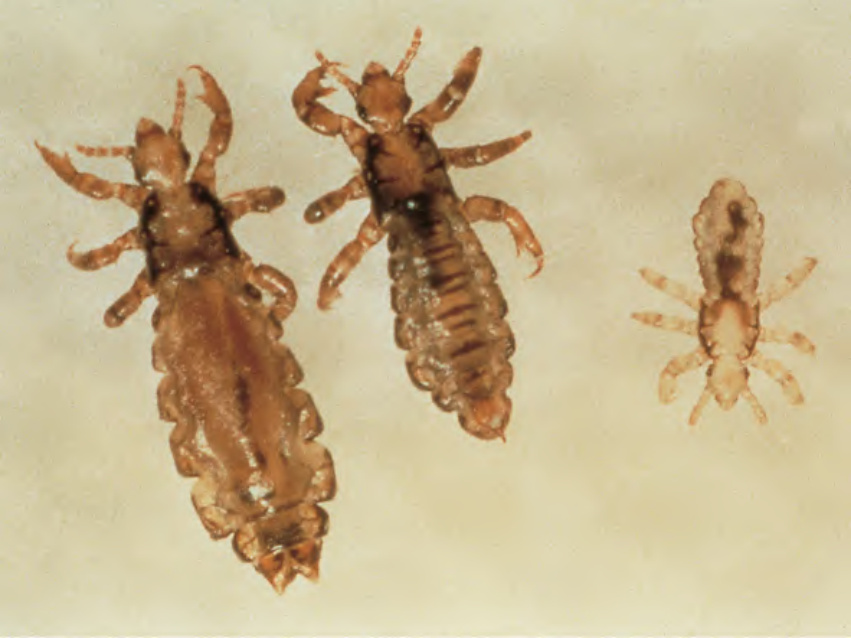
Fig. 84.7 Head louse family. From left to right: female, male, and nymph. With permission from Taplin D, Meinking TL. Infestations. In: Schachner LA, Hansen RC (eds). Pediatric Dermatology, 4th edn. Edinburgh: Mosby, 2011:1141–80.
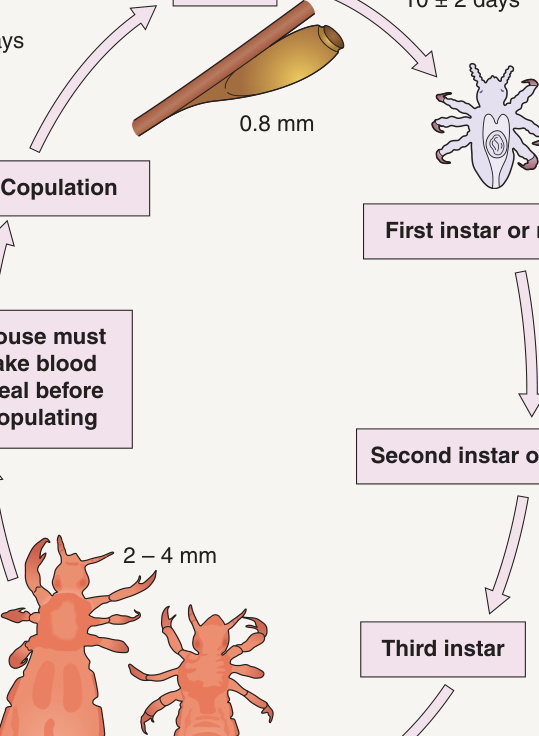
Fig. 84.8 Head louse life cycle (Pediculus capitis).
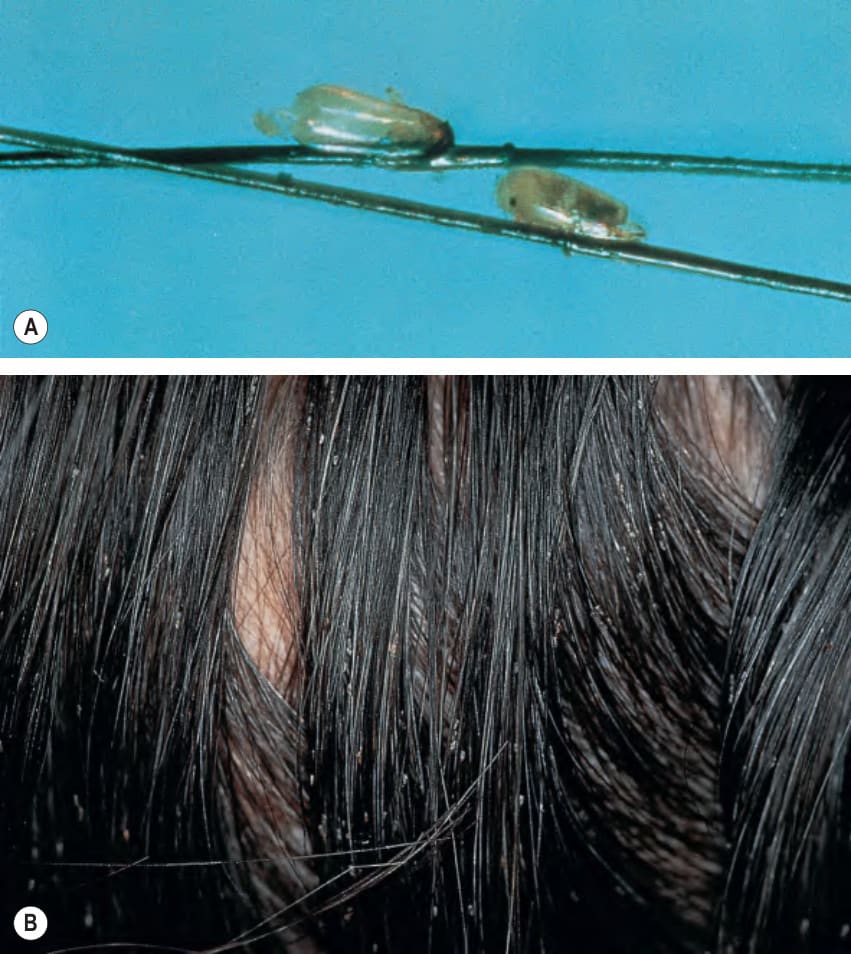
Fig. 84.9 Head lice.A The head louse egg or nit is 0.8 mm in length. B Head lice nits on hair. With permission from Taplin D, Meinking TL. Infestations. In: Schachner LA, Hansen RC (eds). Pediatric Dermatology, 4th edn. Edinburgh: Mosby, 2011:1141–80.
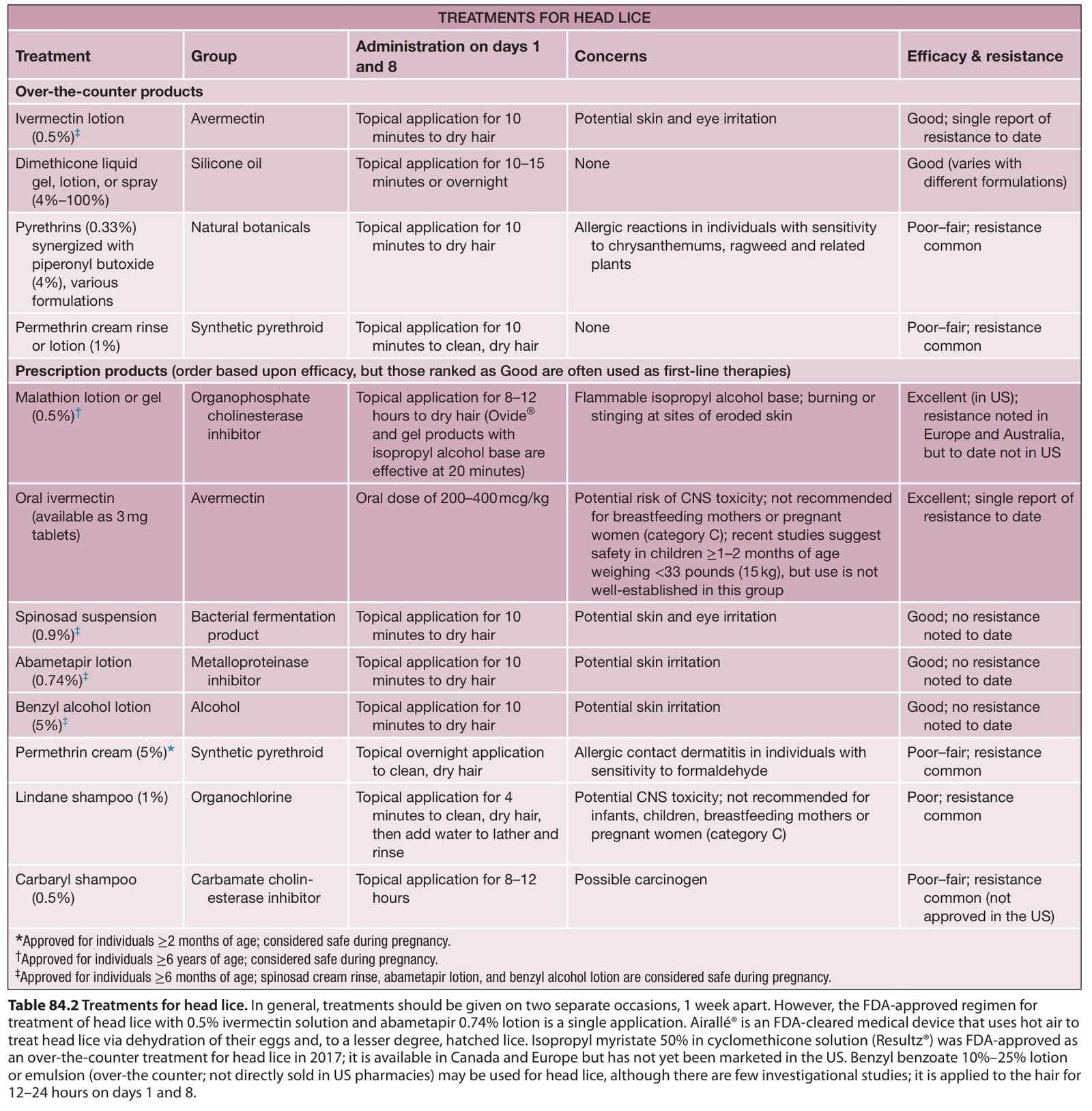
Table 84.2 Treatments for head lice. In general, treatments should be given on two separate occasions, 1 week apart. However, the FDA-approved regimen for treatment of head lice with 0.5% ivermectin solution and abametapir 0.74% lotion is a single application. Airallé® is an FDA-cleared medical device that uses hot air to treat head lice via dehydration of their eggs and, to a lesser degree, hatched lice. Isopropyl myristate 50% in cyclomethicone solution (Resultz®) was FDA-approved as an over-the-counter treatment for head lice in 2017; it is available in Canada and Europe but has not yet been marketed in the US. Benzyl benzoate 10%–25% lotion or emulsion (over-the counter; not directly sold in US pharmacies) may be used for head lice, although there are few investigational studies; it is applied to the hair for 12–24 hours on days 1 and 8.