CRAB LICE
Synonyms:Pthirus pubis or Phthirus pubis Pubic lice Pediculosis pubis “Crabs”
Key features
More properly designated “crab lice” (rather than “pubic lice”)
because infestations may involve other hair-bearing sites such as the beard, eyelashes, axillae, and perianal region
Transmitted by sexual or close contact and to a lesser extent via contaminated clothing, towels, and bedding
Introduction
Infestation with Pthirus pubis, the crab louse, causes discomfort, pruritus, and embarrassment and may coexist with other sexually transmitted infections.
History
The parasitic relationship between humans and crab lice dates back to prehistoric times.
Epidemiology
The incidence rate may be slightly higher in men, probably because they have a greater amount of coarse body hair. Infestations with crab lice can be found in all socioeconomic and ethnic groups, although those of Asian descent or with minimal pubic hair are rarely affected. The incidence of crab lice has decreased with current cultural practices of hair removal from the pubic region. Infestation is most frequently observed in those 15 to 40 years of age, correlating with increased promiscuous sexual activity. The highest prevalence is in men who have sex with men. Although infestation is often considered a sexually transmitted disease, individuals who have had no sexual exposures are occasionally infested via fomite transmission from contaminated clothing, towels, or bedding.
Pathogenesis
Crab lice, Pthirus pubis, are approximately 1 mm in length and resemble tiny crabs, with a wider, shorter body than head lice (Fig. 84.10). Crab lice eggs, which are found attached to human hairs, are viable for up to 10 days; the adult crab louse can live for at least 36 hours away from the host. Crab lice have serrated edges on their first claw that enable them to ambulate on the entire body surface. Thus, infestation occurs not only in pubic hair, but also in hair of the scalp, eyebrows, eyelashes,
moustache, beard, axillae, and perianal area. Indeed, 60% of patients with pubic lice are infested in at least two hair-bearing sites. When the pubic area is shaved or treated, surviving crab lice can travel to other hairy areas of the body, including the scalp.
Clinical Features
Crab lice infestations typically present with pruritus in the pubic region. Crab lice cling to the base of hairs (Fig. 84.11A) and can be brown to skin-colored or mimic hemorrhagic crusts. Other findings may include nits at the base of hair shafts, erythema around hair follicles, excoriations, evidence of a secondary bacterial infection, and lymphadenopathy. When the eyelashes are affected (Fig. 84.11B), feces that accumulate can resemble flecks of mascara. Macula caerulea are asymptomatic, slategray to bluish, irregularly shaped macules that measure 0.5–1 cm in diameter and favor the trunk and thighs. These lesions, which typically develop in chronic crab lice infestations, are thought to result from the breakdown of bilirubin to biliverdin by enzymes in louse saliva.
In individuals with crab lice, the possibility of additional sexually transmitted infections should be considered and the original source of the infestation sought in order to reduce the risk of recurrence.
Pathology
Crab lice cause nonspecific inflammatory changes in the epidermis and dermis. Because lice live on the surface of the skin, they are not evident histologically.
Differential Diagnosis
The identification of crab lice and/or their nits is diagnostic (see Fig. 84.10). Skin diseases associated with pruritus that may be considered in the differential diagnosis include other infestations (e.g. scabies) and arthropod bites. Nits on pubic or axillary hairs must be distinguished from white piedra and trichomycosis pubis or axillaris.
Treatment
Topical insecticides are the standard therapy for crab lice. Sexual partners should be treated simultaneously. Most commonly, permethrin (1% or 5%) and synergized pyrethrin products are utilized (Table 84.3). As with head lice, the topical insecticide should be applied on two occasions, 1 week apart, to ensure complete eradication of hatched eggs. Moreover, all hairy areas of the body must be inspected for the existence of lice and treated if there is a possibility of infestation. A single application of topical products to only pubic hair may limit success rates to as low as 55%.
A Both adult crab lice and nits are evident on pubic hairs. B Crab lice nits and feces on the eyelashes. A, Courtesy Louis A. Fragola, Jr, MD; B, With permission from Taplin D, Meinking TL. Infestations. In: Schachner LA, Hansen RC (eds). Pediatric Dermatology, 4th edn. Edinburgh: Mosby, 2011:1141–80.
Currently, the safest and most effective topical treatment is 5% permethrin cream applied generously overnight to all potentially infested hairy areas, and then repeated 1 week later. Lindane has poor efficacy and higher toxicity, and the shampoo is not approved for extensive body application. Oral ivermectin on days 1 and 8 can be used for patients with perianal or eyelash involvement or when topical therapy is unsuccessful (see Table 84.3).
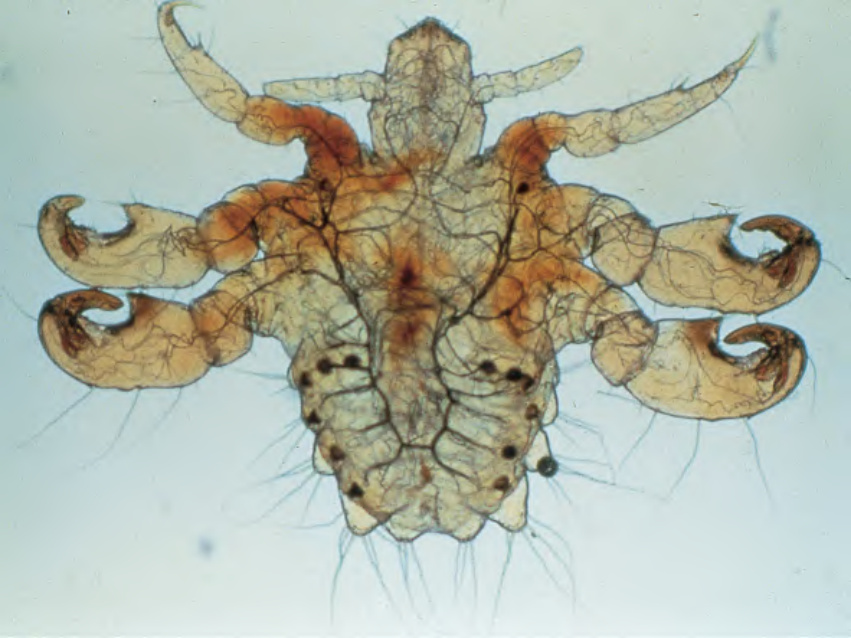
Fig. 84.10 Adult crab louse. Respiratory spiracles and circulatory system are easily seen (45×). Courtesy Tony Burns, MD.
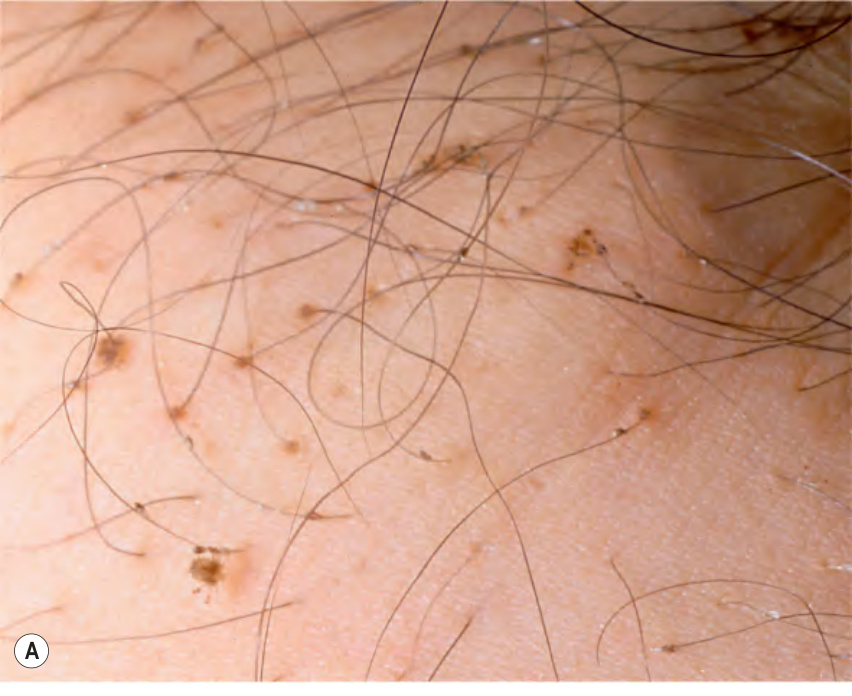
Fig. 84.11 Crab lice.
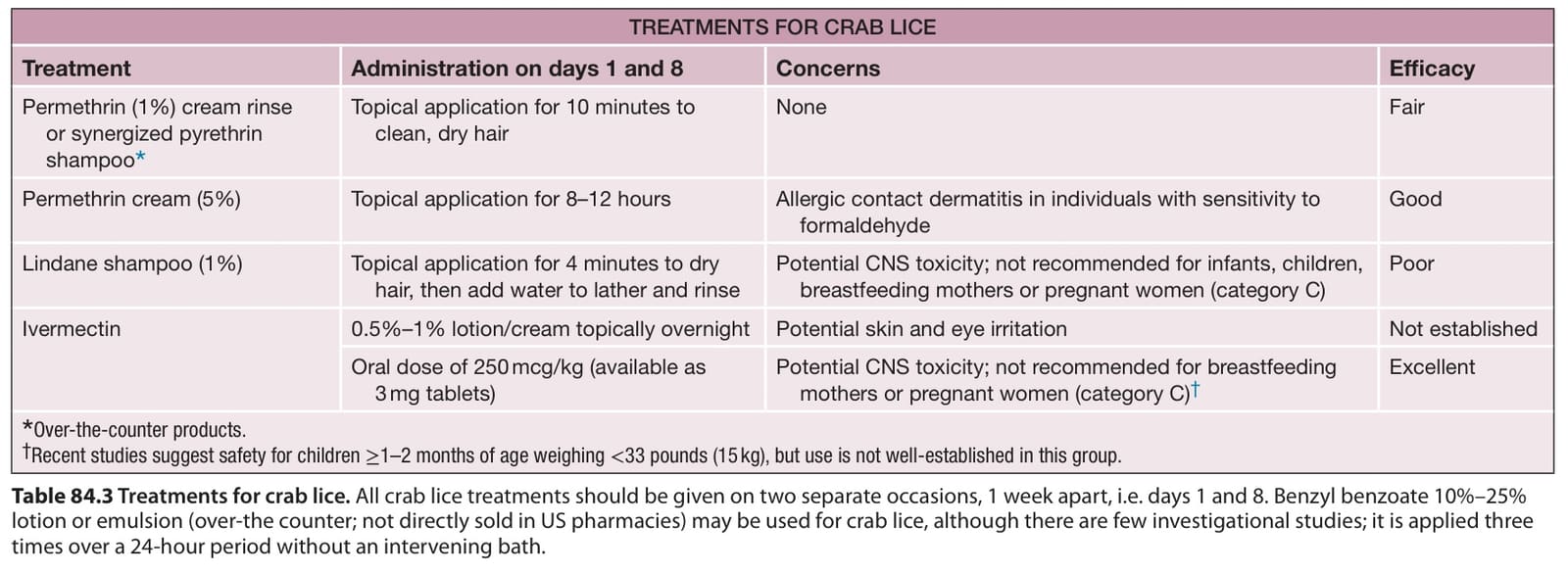
Table 84.3 Treatments for crab lice. All crab lice treatments should be given on two separate occasions, 1 week apart, i.e. days 1 and 8. Benzyl benzoate 10%–25% lotion or emulsion (over-the counter; not directly sold in US pharmacies) may be used for crab lice, although there are few investigational studies; it is applied three times over a 24-hour period without an intervening bath.