BODY LICE
Synonyms: Pediculosis corporis Clothing lice
Key features
An infestation of humans and their clothing, body lice most commonly affect the homeless, refugees, and victims of war and natural disasters
Body lice do not live or lay eggs on people but in their clothing
Infections transmitted by body lice include epidemic typhus, trench fever, and relapsing fever
Introduction
Body lice infestations are associated with overcrowding, poor hygiene, poverty, war, and natural disasters. These insects are the primary vectors for diseases caused by Rickettsia, Borrelia and Bartonella spp. (see Chs. 74 & 76). Body lice resemble head lice but are larger in size.
Epidemiology
Body lice are found worldwide. Increased prevalence rates of body lice are tied to poor hygiene, poverty, and homelessness. There are no racial, age, or sex restrictions.
Pathogenesis
Pediculosis corporis is caused by an infestation of humans and their clothing by Pediculus humanus var. corporis. In addition to exposure to conditions conducive to obtaining body lice, infestation requires an inability to wash and change clothes.
Several important human diseases are transmitted by the body louse. These include epidemic typhus (Rickettsia prowazekii) and relapsing fever (Borrelia recurrentis) as well as several diseases caused by Bartonella quintana – trench fever, bacillary angiomatosis, and endocarditis. Whether this louse has a role in transmission of Acinetobacter baumannii or Yersinia pestis to humans remains to be determined. Transmission of microorganisms from body lice to humans occurs not from louse bites, but rather from inoculation of louse feces into the skin via scratching or by inhalation of dry, powdery louse feces from infested bedding or clothing.
Clinical Features
P. humanus var. corporis measures between 2.5 and 4.0 mm in length. Unlike head and crab lice, the nits and lice are rarely found on the patients’ skin, save for feeding, as they reside primarily on the clothing of their hosts. This infestation leads to severe pruritus. The back, neck, shoulders, and waist areas are commonly involved. Clinical findings include pinpoint red macules, small erythematous papules, crusts and excoriations, occasionally complicated by impetigo and lymphadenopathy. Blood and fecal pellets often stain clothing and bedding. On inspection, nits and adult lice are found along clothing seams that are in contact with the neck, axillae, and waistline (Fig. 84.12).
Pathology
The epidermis has minimal spongiosis with nonspecific infiltrates of eosinophils and neutrophils in the dermis.
Differential Diagnosis
Other causes of widespread pruritus and excoriations that may be considered in the differential diagnosis of body lice include systemic diseases (e.g. hepatic or renal impairment), drug reactions, atopic dermatitis, contact dermatitis (irritant or allergic), and other infestations (e.g. scabies).
Treatment
Preferably, the clothing and bedding of infested individuals should be discarded in tightly sealed, plastic biohazard bags and incinerated.
Only if the latter is not possible should disinfection be attempted. This involves fumigating the clothing or laundering it using hot water (temperature of ≥130°F/55°C), followed by machine drying with high heat. Hot ironing of the seams of upholstered furniture can also be performed, and exposure to untreated infested items should be strictly avoided for 2 weeks. Topical insecticide regimens similar to those used for scabies can eradicate concurrent scabies or crab lice infestations as well as kill any body lice adherent to hairs.
Mass delousing in crowded, large populations due to natural disaster, war, or famine is accomplished by dusting powders. These powders may contain DDT, malathion, dieldrin, lindane, or permethrin.
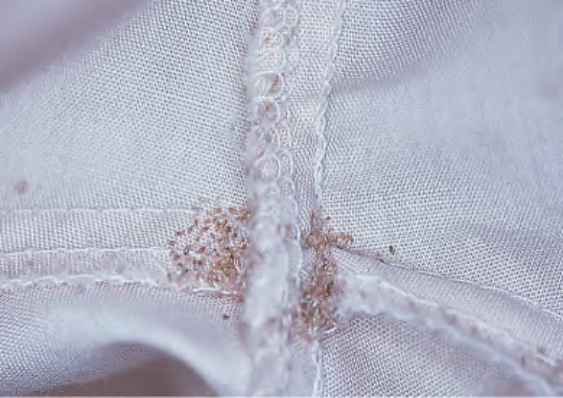
Fig. 84.12 Body lice eggs in the seams of clothing.
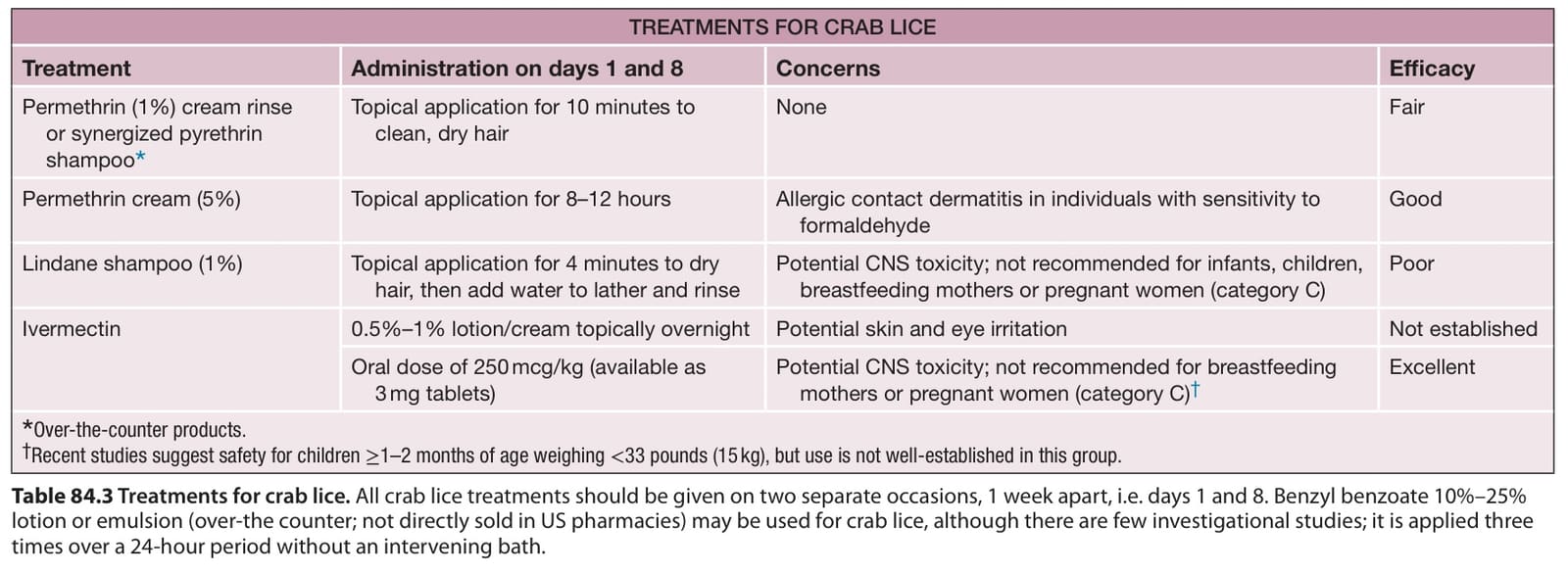
Table 84.3 Treatments for crab lice. All crab lice treatments should be given on two separate occasions, 1 week apart, i.e. days 1 and 8. Benzyl benzoate 10%–25% lotion or emulsion (over-the counter; not directly sold in US pharmacies) may be used for crab lice, although there are few investigational studies; it is applied three times over a 24-hour period without an intervening bath.