TUNGIASIS
Synonyms:Tunga penetrans: chigoe flea, jigger flea, burrowing flea, sand flea Pique Nigua Pio and bicho de pie
Key features
This infestation is caused by the burrowing flea, Tunga penetrans
It is endemic in the Caribbean islands and parts of Central and
South America, Africa, Pakistan, and India
The female flea burrows into the skin and then enlarges to create a nodule with a central punctum through which eggs are ejected
Introduction
The burrowing flea, Tunga penetrans, is the causative agent of tungiasis. A female flea burrows into the upper dermis and enlarges to approximately 1 cm in diameter, creating a nodule with a central punctum through which eggs (fertilized or unfertilized) are eventually discharged.
History
Tungiasis was first reported in crew members on Christopher Columbus’ original trip to the New World in 1492.
Epidemiology
Tungiasis can occur in anyone exposed to the flea, regardless of sex, race, or age. Areas of high incidence include the Caribbean islands, parts of Central and South America, and sub-Saharan Africa. In endemic areas, risk factors include walking barefoot, wearing open-toed shoes, and living in homes with dirt or unclean floors.
Pathogenesis
Tunga penetrans is a wingless flea that is 1 mm in size and usually lives in warm, dry soil. Both sexes of this flea require an occasional blood meal from a warm-blooded animal for maturation. Due to the fleas’ limited jumping ability, the most common location for bites is the foot. Female fleas, rather than simply obtaining a blood meal, burrow headfirst into mammalian skin. They subsequently undergo marked abdominal hypertrophy, growing to 1 cm in diameter. The flea protrudes its rear cone through a central punctum that is always maintained; whether or not fertilization occurs via mating of the embedded female flea with a free-roaming male flea, over a hundred eggs are discharged within 3 weeks. After expelling the eggs, the female dies and its remains are eventually sloughed from the skin.
Clinical Features
Bites of immature fleas cause no symptoms; however, burrowing of the female flea into the skin can cause significant clinical morbidity. The burrowing is initially asymptomatic, but varying degrees of pain or pruritus usually develop. The first sign of disease is a small black dot, which evolves into a pearl-like whitish papule and then a larger nodule that is said to resemble a watch glass, with a clearly demarcated white halo surrounding the black central punctum. A peripheral zone of erythema is frequently evident. When the flea dies, a black crust covers the involuting lesion. The Fortaleza classification scheme divides tungiasis into stages based upon symptoms, lesion size and the clinical appearance.
The most common site of disease is the periungual area of the toes, followed by the soles and toe webs (Fig. 84.13). Ulceration, secondary infection, and lymphangitis can occur; less frequent complications include tetanus, gangrene, and amputation of a digit. Over half of periungual infections lead to deformation or loss of the nail, and heavy infestations produce substantial morbidity in resource-poor communities within endemic areas.
Pathology
A nonspecific inflammatory infiltrate surrounds the flea within the dermis.
Differential Diagnosis
The differential diagnosis may include myiasis, tick bite reactions, cercarial dermatitis, pyoderma, plantar warts, verruga peruana, and squamous cell carcinoma.
Treatment
Spontaneous recovery does occur; however, most clinicians and patients prefer to treat the infestation by removal of the female flea. In an early infestation, a sterile needle can be used to pry the insect from the skin. Covering the punctum with dimethicone, liquid paraffin, or a mixture of neem and coconut oils may prevent flea growth and expedite removal. If treatment is delayed, curettage, electrodesiccation, or surgical excision may be required. Careful cleaning of the cystic cavity speeds clinical resolution, and antibiotic therapy may be needed for secondary infections. Tetanus prophylaxis should be strongly considered. Topical application of ivermectin, metrifonate, or thiabendazole may lead to more rapid demise of embedded fleas, but this has limited clinical benefit. In a randomized controlled study, oral ivermectin was not found to have significant efficacy compared to placebo.
Preventative measures include wearing closed shoes or boots and avoiding ground contact in endemic areas. A plant-based insect repellent containing coconut and jojoba oils has also been shown to prevent sand flea infestation.
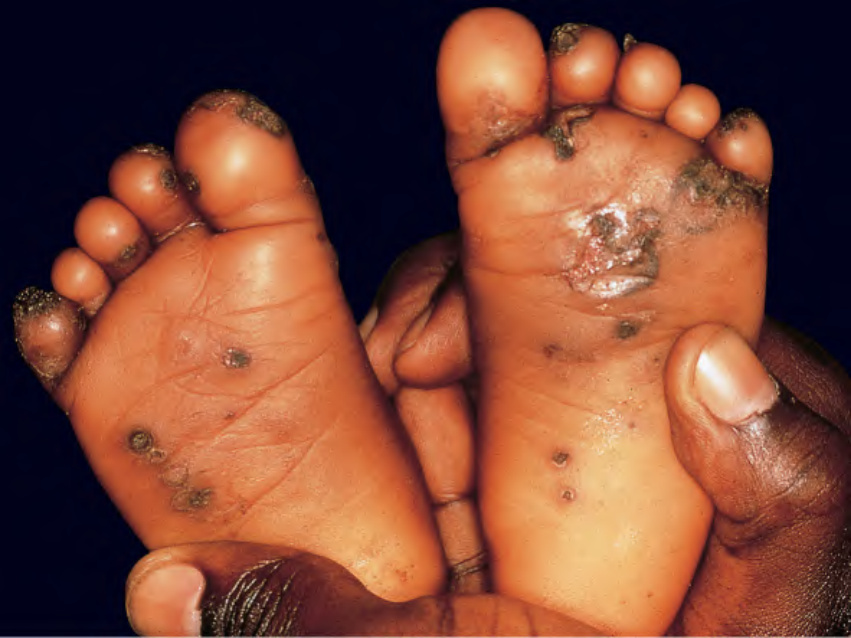
Fig. 84.13 Tungiasis in a child.