TREATMENT
A detailed discussion of the management of drug addiction is beyond the scope of this chapter. When providing care to persons suspected of drug use disorder, it should be remembered that even admission of drug use is difficult, as patients risk disapproval and overt or concealed rejection even from medical professionals.
The selection of antibiotics to treat skin infections should be guided by antibiotic sensitivities of the cultured organisms (Table 89.5). With the emergence of community-acquired MRSA and the increased risk of polymicrobial infections, broad-spectrum coverage is recommended until culture results and antibiotic sensitivities are determined.
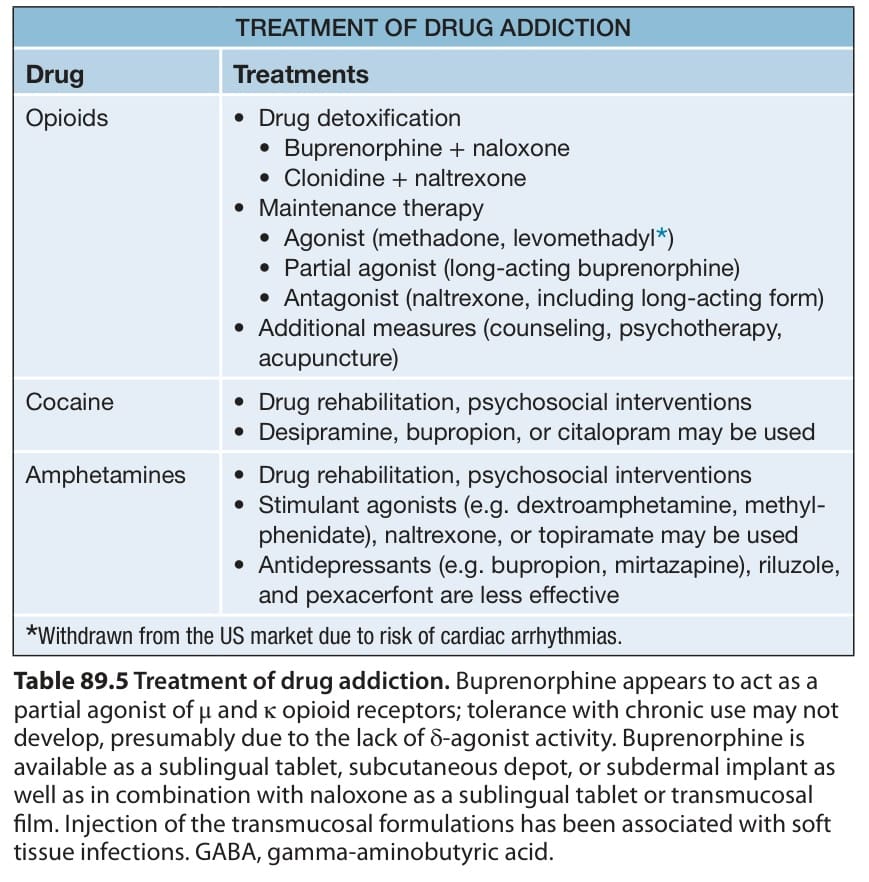
Table 89.5 Treatment of drug addiction. Buprenorphine appears to act as a partial agonist of μ and κ opioid receptors; tolerance with chronic use may not develop, presumably due to the lack of δ-agonist activity. Buprenorphine is available as a sublingual tablet, subcutaneous depot, or subdermal implant as well as in combination with naloxone as a sublingual tablet or transmucosal film. Injection of the transmucosal formulations has been associated with soft tissue infections. GABA, gamma-aminobutyric acid.
However, even with aggressive surgical and medical treatment, the mortality rate of necrotizing fasciitis in drug addicts is ~20% and limb amputation is necessary in another 18%, necessitating prompt recognition and surgical consultation.
Skin grafting of large ulcers may be necessary when healing does not occur with compression and appropriate dressings. Some substance abusers may deliberately sabotage the skin graft by injecting through it or into the vacuum (VAC) dressing tubing. Recovered parenteral drug users often wear long-sleeved shirts and other garments to hide the stigmata of their past addiction and may seek help in diminishing the appearance of these signs. Hypertrophic scars improve with intra-lesional injections of corticosteroids and pulsed dye laser treatments (see Ch. 98). Hyperpigmented scars require the use of pigment-specific lasers and bleaching agents, including hydroquinone. Tissue augmentation with hyaluronic acid or fat can improve the appearance of depressed scars. Such scars may also respond to low-fluency treatments with visible light lasers.
Statistical Manual of Mental Disorders: DSM-5.5th ed. Washington, D.C: American Psychiatric Association; 2013.2. Hasin DS, O’Brien CP, Auriacombe M, et al. DSM-5 criteria
Administration. Key substance use and mental health indicators in the United States: results from the 2019 National Survey on Drug Use and Health (HHS Publication No. PEP20-07-01-001, NSDUH Series H-55). Rockville, MD: Center for Behavioral Health Statistics and Quality, Substance Abuse and Mental Health Services Administration; 2020. Available at: https://www.samhsa. gov/data/.
Table 89.5 Treatment of drug addiction. Buprenorphine appears to act as a partial agonist of μ and κ opioid receptors; tolerance with chronic use may not develop, presumably due to the lack of δ-agonist activity. Buprenorphine is available as a sublingual tablet, subcutaneous depot, or subdermal implant as well as in combination with naloxone as a sublingual tablet or transmucosal film. Injection of the transmucosal formulations has been associated with soft tissue infections. GABA, gamma-aminobutyric acid.