MISCELLANEOUS
Intralesional Corticosteroids
Foreign body reactions to intralesional corticosteroids are quite rare despite the widespread use of this treatment modality. Reactions result from failure of the injected material to disperse in the usual manner or from incomplete absorption, leaving a small residuum that evokes a foreign body reaction.
Histologically, pools of granular, lightly stained material surrounded by a histiocytic and foreign body granulomatous infiltrate are seen in the dermis. Cellular reactions are absent around sites of recent injections.
Sutures
Nylon and polypropylene sutures used in contemporary surgery are relatively inert (see Ch. 144), but most other materials regularly produce chronic inflammation and granuloma formation (see Fig. 151.19). The incubation period varies from weeks to years.
The incision site may appear inflamed, red, and edematous. A sinus tract may develop, through which the suture material is extruded. Inflammation persists until the suture material is totally removed.
Histologically, granulomatous inflammation of various types is seen surrounding suture material: foreign body, histiocytic, palisading, or a combination thereof (see Fig. 94.2). Transepidermal elimination of the suture material occurs.
Polyamide “Hair” Implants
In patients with androgenetic alopecia in whom autologous hair transplantation is not feasible (e.g. inadequate donor sites), polyamide “hair” fibers have been used for synthetic scalp hair restoration. Although some authors have reported complications in only ~1% of patients, foreign body reactions are a real risk (Fig. 94.12). Polyamide fiber hair restoration is not approved in the US.
In addition to multiple perifollicular granulomas, there is evidence of chronic folliculitis.
Mesotherapy
Mesotherapy involves placement of a pharmacologic substance into the “mesoderm” (dermis and subcutis). For example, injections of deoxycholic acid (Kybella®) have been approved for the reduction of submental fat and may lead to a temporary chemical panniculitis. However, non-standardized combinations such as phosphatidylcholine plus a detergent solvent (e.g. deoxycholic acid) are also used for lipolysis. With
these latter combinations, irritant cutaneous necrosis and atypical mycobacterial infections have been observed as well as granulomatous reactions. Lastly, application of moisturizers prior to microneedling for facial rejuvenation can lead to granulomatous reactions.
Gouty tophi
Gouty tophi consisting of urate crystals form multiple lobules separated by fibrous septa surrounded by histiocytes and multinucleated foreign
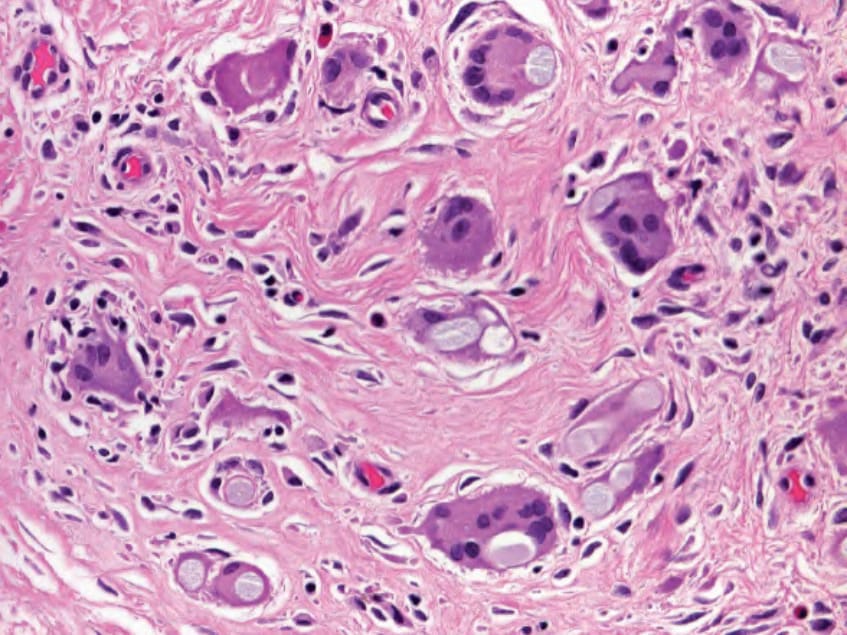
Fig. 94.2 Foreign body reaction to sutures. The foreign bodies have been engulfed primarily by foreign body-type giant cells; one Langhans-type giant cell is present at 12 o’clock. Courtesy Lorenzo Cerroni, MD.
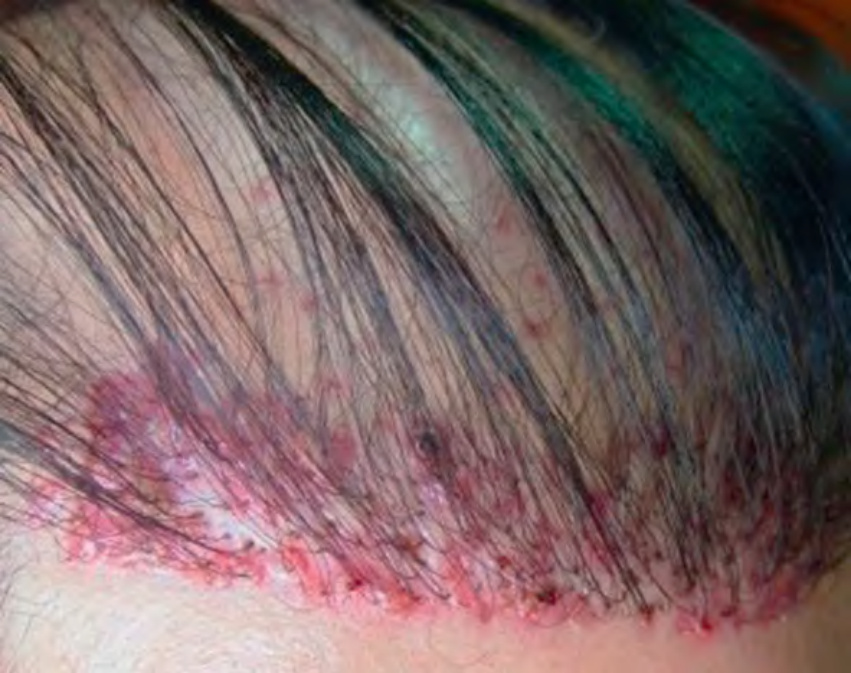
Fig. 94.12 Foreign body reactions to polyamide synthetic “hair” implantation.
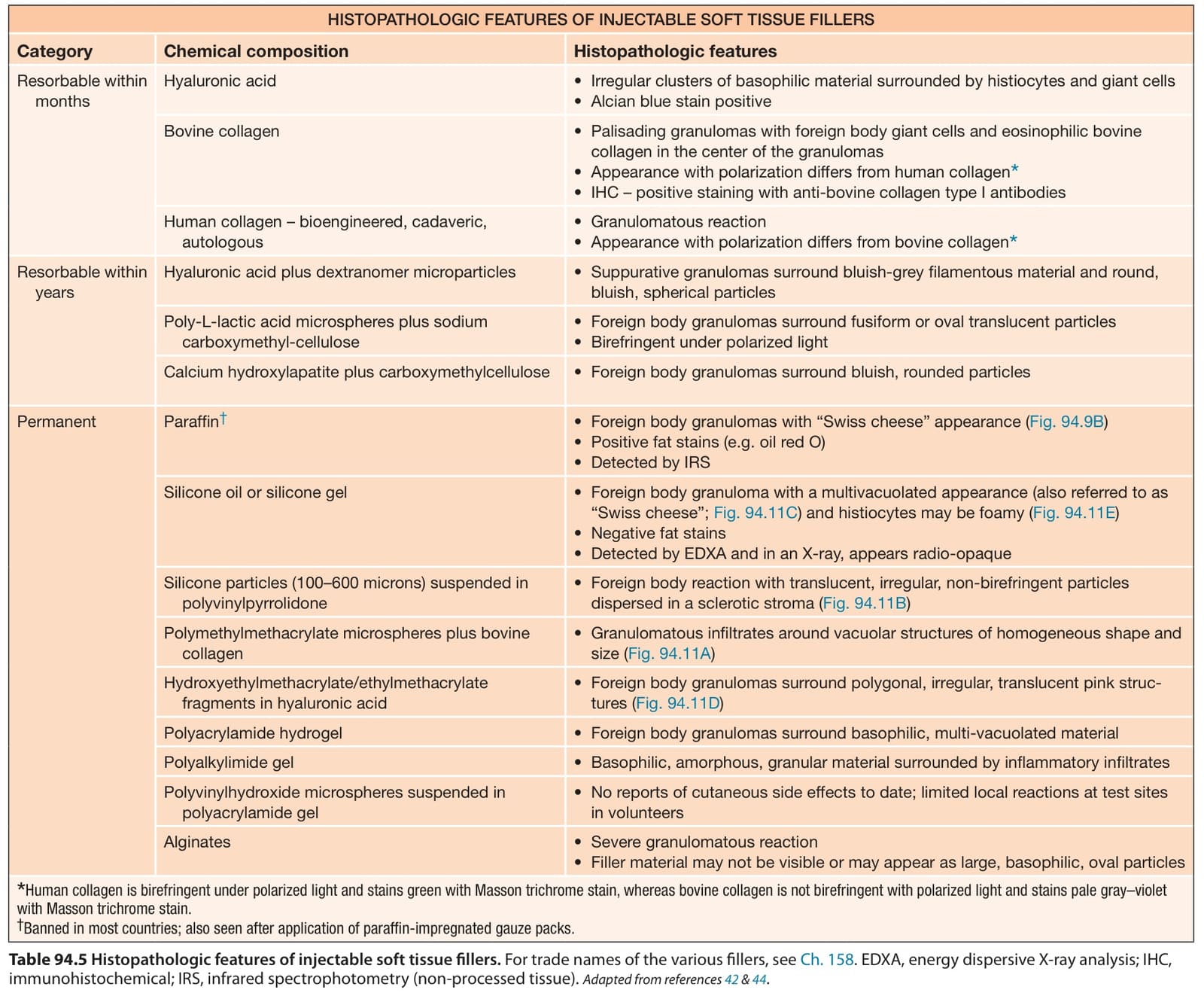
Table 94.5 Histopathologic features of injectable soft tissue fillers. For trade names of the various fillers, see Ch. 158. EDXA, energy dispersive X-ray analysis; IHC, immunohistochemical; IRS, infrared spectrophotometry (non-processed tissue). Adapted from references & .
body giant cells, resembling a foreign body reaction (see Fig. 48.3). In long-standing tophi, calcium pyrophosphate dehydrate crystals have been detected and they may be dispersed or condensed and present at the edge or inside the tophus lobules. These calcium crystals appear to be a late event and may contribute to the persistence of gout tophi despite success in lowering serum urate levels.